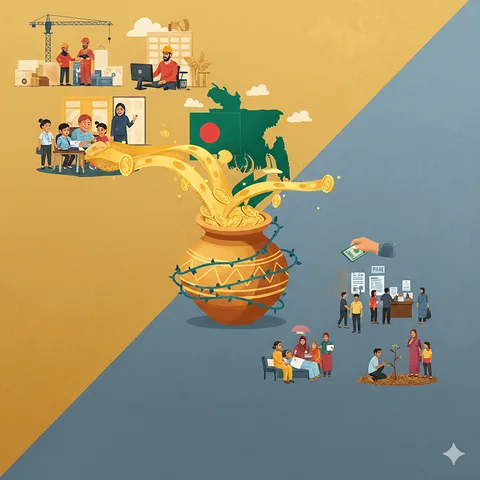
GDP: The Pulse of a Nation’s Economy Explained
GDP: The Pulse of a Nation’s Economy ExplainedIntroductionImagine visiting a doctor. They check your temperature, pulse, and blood pressure to understand your health. Economists do something similar to measure a country’s economic health. They check its GDP.But what exactly is G…
লিখেছেন Shake Hasan
৭ মিনিটে পড়া যাবে৫-এ ৫.০, ১ টি রেটিং
GDP: The Pulse of a Nation’s Economy Explained
Introduction
Imagine visiting a doctor. They check your temperature, pulse, and blood pressure to understand your health. Economists do something similar to measure a country’s economic health. They check its GDP.
But what exactly is GDP? Why do politicians, economists, and news channels talk about it endlessly? Why does it matter in your life, your job prospects, your investments, or even the price of your groceries?
In this article, we will unravel GDP in its deepest sense – its meaning, calculation, types, limitations, and impact on daily life – with real-world examples and global comparisons. By the end, you will not only understand GDP but also see the world economy through a sharper lens's
1. What is GDP?
GDP stands for Gross Domestic Product. In simplest words:
➡️ GDP is the total monetary value of all final goods and services produced within a country’s borders in a specific time period (usually a year or a quarter).
Think of everything produced in your country in a year: cars, clothes, haircuts, software, food, education services – all of these contribute to GDP.
Key Words Explained
- Gross: Before deducting depreciation (wear and tear of machinery, buildings, etc.)
- Domestic: Within a country’s geographical boundary
- Product: Goods and services produced
2. Why is GDP Important?
GDP is important because:
✅ Economic health indicator – Like your temperature indicates health, GDP indicates how well an economy is doing.
✅ Policy decisions – Governments and central banks use GDP to decide policies, taxes, interest rates, and development budgets.
✅ Investor confidence – Investors globally analyze GDP growth to invest in countries with rising economic potential.
✅ Standard of living comparison – GDP per capita helps compare the average income and living standards of countries.
✅ Job creation and business growth – Higher GDP generally means more jobs and better business opportunities.
3. Types of GDP
There are three main types of GDP used in economics:
3.1 Nominal GDP
This is GDP measured at current market prices, not adjusted for inflation. It can increase just because prices increased, even if production stayed the same.
Example:
If Bangladesh produced 100 mangoes at $1 each in 2022, Nominal GDP = $100.
If in 2023, it produced the same 100 mangoes but each cost $1.20, Nominal GDP = $120.
Production stayed the same, only prices rose.
3.2 Real GDP
Real GDP adjusts for inflation to measure true growth in production. It tells whether the economy produced more, regardless of price changes.
Using the mango example, if inflation is 20%, the Real GDP remains at $100, meaning no real growth happened.
3.3 GDP per Capita
This is GDP divided by total population. It indicates average income and standard of living.
Example:
If a country’s GDP is $1 trillion with 100 million people, GDP per capita is $10,000.
4. How is GDP Calculated?
There are three approaches to calculate GDP. All three should theoretically give the same result.
4.1 Production (Output) Approach
Adds up the value-added at each production stage in the economy.
Example (Bread Production Chain):
- Farmer sells wheat for $1
- Miller grinds wheat into flour and sells for $3 (value added $2)
- Baker makes bread and sells for $5 (value added $2)
GDP = $1 + $2 + $2 = $5
This avoids double counting.
4.2 Income Approach
Adds up all incomes earned by individuals and businesses:
- Wages and salaries
- Profits
- Rents
- Interest incomes
It represents the total income generated in the economy.
4.3 Expenditure Approach
Most popular method. Adds up all spending on final goods and services:
Formula:
GDP = C + I + G + (X – M)
Where,
- C = Consumption (household spending)
- I = Investment (business investments in machinery, construction, etc.)
- G = Government spending (schools, roads, defense, salaries)
- X = Exports
- M = Imports
So, GDP = Consumption + Investment + Government spending + Net Exports
Example:
If a country spends:
- $500 billion on consumption
- $200 billion on investment
- $300 billion on government expenditure
- Exports $100 billion
- Imports $150 billion
GDP = 500 + 200 + 300 + (100 – 150) = $950 billion
5. GDP and Economic Growth
When GDP increases over time, it indicates economic growth. It means the country is producing more, creating more jobs, and people are earning and spending more.
Example: China’s Growth
China’s GDP in 2000 was ~$1.2 trillion. In 2023, it crossed $17 trillion, lifting millions out of poverty.
6. Limitations of GDP
GDP is crucial but has limitations:
✅ Doesn’t measure happiness – A country might have high GDP but unhappy citizens due to inequality or poor health.
✅ Ignores unpaid work – Housework, caregiving, volunteering aren’t counted, despite their huge societal value.
✅ Ignores environmental costs – GDP rises with pollution-heavy industries without deducting environmental damage.
✅ Black economy excluded – Informal sectors or illegal transactions aren’t included, underestimating true economic activity.
✅ No income distribution insights – GDP per capita is an average; it doesn’t show if wealth is concentrated among a few.
7. GDP vs GNP
Often confused terms:
- GDP (Gross Domestic Product): Measures production within a country.
- GNP (Gross National Product): Measures production by nationals of a country, whether within or outside its borders.
Example:
A Bangladeshi company operating in Dubai adds to Bangladesh’s GNP but not GDP.
A foreign company operating in Bangladesh adds to Bangladesh’s GDP but not GNP.
8. Global GDP Comparisons
As of 2024 (approximate figures):
Country
GDP (Nominal)
USA
$28 trillion
China
$17 trillion
Japan
$4 trillion
Germany
$4 trillion
India
$3.8 trillion
Bangladesh
$460 billion
(Source: IMF/World Bank estimates)
9. GDP and Currency Strength
Higher GDP often strengthens a country’s currency due to global investor confidence. However, trade balances, debt, and political stability also influence currency value.
10. Real-life Impact of GDP on You
Here’s how GDP growth or decline affects everyday life:
✅ Job Market: Rising GDP → businesses expand → more jobs
✅ Salary Growth: Higher GDP → companies earn more → better pay raises
✅ Inflation and Prices: Excessive GDP growth can overheat economy → rising inflation
✅ Interest Rates: Central banks adjust rates to control growth and inflation
✅ Business Opportunities: Strong GDP growth attracts foreign investments, boosting entrepreneurial prospects
✅ Government Services: Higher GDP → higher tax revenue → better public services
11. Criticism of GDP Obsession
Many economists argue GDP shouldn’t be the sole focus. Alternative indexes like Human Development Index (HDI) and Gross National Happiness (GNH) consider health, education, environment, and well-being.
12. The Future of GDP Measurement
With AI automation, green economies, and digital services rising, economists debate:
- Should GDP include unpaid digital work (e.g. content creation)?
- How to deduct environmental damage from GDP?
- How to value mental health, happiness, and sustainability?
13. Final Thoughts
GDP remains the most popular tool to measure economic health. Like your weight or blood pressure, it doesn’t tell everything about your well-being, but it is a critical starting point.
Understanding GDP helps you:
✅ Follow economic news with clarity
✅ Make informed investment decisions
✅ Analyze government policies
✅ See beyond simplistic “growth” headlines to real human progress
14. Conclusion
We live in a world where GDP drives political promises, market trends, and development goals. As a conscious citizen, entrepreneur, or policymaker, knowing what GDP means – and what it misses – empowers you to think critically about economic growth and its impact on human life.
So next time you hear “GDP grew by 4% this quarter,” pause and ask: “Does this really mean people are living better, or is it just a number?”
এই লেখাকে রেটিং দিন
মন্তব্য
এখনও মন্তব্য নেই