
How Artificial Intelligence Is Rewiring the Future of Global Politics
The world stands at a critical juncture. Artificial Intelligence (AI), once confined to research labs and sci-fi dreams, is now entrenching itself into the core of human governance. From campaign strategies in Washington to surveillance systems in Beijing, AI is rapidly transfor…
লিখেছেন Shake Hasan
৬ মিনিটে পড়া যাবে৫-এ ৫.০, ১ টি রেটিং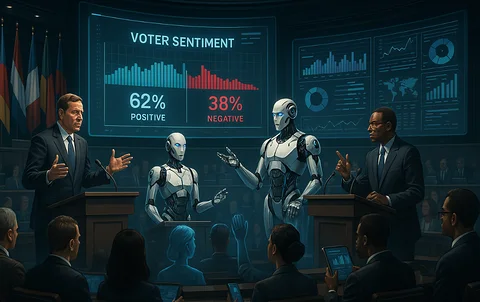
The world stands at a critical juncture. Artificial Intelligence (AI), once confined to research labs and sci-fi dreams, is now entrenching itself into the core of human governance. From campaign strategies in Washington to surveillance systems in Beijing, AI is rapidly transforming how political power is created, maintained, and contested. As we grapple with this seismic shift, the pressing question becomes not whether AI will shape politics—but how deeply, how quickly, and with what consequences.
Part I: The Rise of AI in Governance
1.1 From Data to Decision-Making
Modern political systems, both democratic and authoritarian, are fueled by data. AI thrives in such ecosystems. With the ability to parse billions of data points in real time, AI algorithms are increasingly used in:
- Policy modeling: Predictive models simulate the outcomes of policies before implementation.
- Public sentiment analysis: Governments and parties use NLP (Natural Language Processing) tools to monitor citizen emotions from social media or news feeds.
- Automated bureaucracy: Estonia’s e-government is a model for how AI can process tax returns, health claims, and licenses with near-zero human input.
1.2 Authoritarian Acceleration
In China, the state’s use of AI for social control is already a reality. The Social Credit System integrates facial recognition, geolocation, financial history, and social behavior into a unified surveillance mechanism. This model is spreading quietly to other countries, often under the guise of “public safety” or “anti-corruption” campaigns.
1.3 Democratic Drift
In contrast, Western democracies face a more complex dance. They embrace AI for efficiency and insight but wrestle with its darker side: disinformation, voter manipulation, and algorithmic bias. Tools like Cambridge Analytica proved AI’s potency in shaping public opinion—but also exposed vulnerabilities in electoral systems.
Part II: Campaigning in the Age of Algorithms
2.1 Microtargeting Voters
Political campaigns now deploy AI-driven tools that segment voters into hyper-specific categories based on psychographic and behavioral profiles. Each user might see a tailored message designed to resonate emotionally, not rationally. The implications are profound:
- Political discourse becomes fragmented.
- Issues are reduced to clickable slogans.
- Truth becomes relative, driven by engagement metrics.
2.2 Bots, Trolls, and the Battle for Attention
Sophisticated AI-generated bots now mimic real humans with near-perfect fluency. During key elections (e.g., 2016 U.S. and 2022 Brazilian elections), armies of bots were deployed to:
- Spread fake news.
- Amplify polarizing content.
- Drown out moderate voices.
This chaos is not always organic. State-sponsored actors (like Russia’s IRA or China’s 50 Cent Army) use AI as a geopolitical weapon.
2.3 Deepfakes and Synthetic Campaigning
With the rise of generative AI, politicians’ voices, faces, and even gestures can be convincingly faked. In the next election cycles, we may witness:
- Deepfake debates between fake versions of candidates.
- AI-generated attack ads indistinguishable from real footage.
- Entire campaigns run by algorithmic decision-makers.
Part III: Legislating AI—A Governance Crisis
3.1 The Legal Vacuum
Most legal frameworks today are ill-equipped to regulate AI. Legislators, often decades behind technologists, face challenges such as:
- Defining AI accountability.
- Distinguishing between data-driven persuasion and manipulation.
- Creating enforceable international norms.
3.2 Ethical Dilemmas
AI ethics is murky terrain. Should predictive policing algorithms be used if they disproportionately target minorities? Should an AI judge be allowed to sentence a criminal based on historical data?
These questions aren’t theoretical. They’re real, present, and unresolved in countries experimenting with digital courts or algorithmic bail systems.
3.3 The Global Race
Geopolitically, AI governance is now a power game. The U.S., China, EU, and India are racing to set global AI standards. Whoever sets the rules will dominate the future of political infrastructure—much like the U.S. did with the Bretton Woods system post-World War II.
Part IV: AI Politicians and Algorithmic Power
4.1 Could an AI Run for Office?
In 2022, a satirical campaign in Japan launched “AI Mayor”—a chatbot candidate that answered voter questions better than real politicians. In Estonia, AI advisors already influence urban planning decisions. These experiments raise a provocative possibility:
Will future political leaders be human—or hybrid systems?
4.2 The Promise of Neutrality
AI, theoretically, offers apolitical governance. Algorithms don’t bribe, tire, or seek re-election. They could:
- Eliminate bureaucratic inefficiencies.
- Reduce corruption.
- Make data-driven policy transparent.
But in reality, algorithms reflect the biases of their creators. If an AI is trained on biased data, its neutrality is a mirage.
4.3 Algorithmic Despotism?
A darker vision emerges: automated authoritarianism. Imagine a future where:
- Voter behavior is predicted and controlled via microincentives.
- Dissent is algorithmically suppressed through “pattern disruption” in online spaces.
- Policy changes are rolled out based on predicted compliance, not public will.
In such a world, the social contract is not negotiated—it is simulated and enforced.
Part V: Citizens in the Machine—Public Agency in the AI Era
5.1 Civic Tech vs. Surveillance Tech
Not all AI applications are top-down. Grassroots movements are harnessing AI for:
- Fact-checking political speeches in real time.
- Mapping lobbying activity and government contracts.
- Enabling participatory budgeting via chatbots.
Yet, these tools remain niche. The asymmetry of power between state-level AI and civil society tools remains vast.
5.2 The Digital Divide
AI governance risks exacerbating inequalities. Nations with advanced AI infrastructure (like the U.S. and China) could dominate global decision-making, while smaller states lag behind.
Within nations, AI tools may privilege the digitally literate, marginalizing rural or older populations. Democracy, then, risks becoming a high-tech echo chamber for the elite.
5.3 AI Literacy as a Civic Duty
To resist manipulation, citizens must understand the tools shaping their opinions. Future education systems must teach:
- Media literacy beyond fake news.
- Data awareness—how your digital footprint feeds AI.
- Algorithmic accountability—how to demand transparency.
Part VI: The Road Ahead—Scenarios for AI and Politics
6.1 Scenario 1: The Benevolent Technocracy
Governments use AI to enhance services, reduce corruption, and increase transparency. AI becomes an invisible helper—quietly optimizing cities, welfare systems, and climate policy.
Pros: Efficiency, trust, public welfare
Cons: Overreliance on technology, erosion of human judgment
6.2 Scenario 2: Algorithmic Authoritarianism
Autocratic regimes perfect AI-based control. Elections become performative. Surveillance is total. Dissent disappears algorithmically.
Pros: Stability, predictability
Cons: Loss of freedom, institutionalized oppression
6.3 Scenario 3: Democratic Resistance
A global civic awakening leads to AI democratization. Citizen assemblies oversee algorithmic governance. Digital co-ops manage public data.
Pros: Empowered public, digital justice
Cons: Slow adaptation, high coordination costs
Conclusion: The Fight for the Political Soul of AI
AI will not remain neutral. It will either entrench power or redistribute it. It will either suppress agency or amplify it. The difference depends on how we—politicians, technologists, activists, citizens—choose to build it.
In the 21st century, the algorithm will become the new constitution. And the code will either write a future of dignity and justice—or tyranny and silence.
The political challenge of our era is clear:
Who will govern the governors? Who will program the programmers? Who will audit the algorithms of power?
Author’s Note: This article is a call to awareness, not alarmism. The AI age is not a threat to politics. It is politics—just in a new form. Whether we evolve into an Algorithmic Republic or a Digital Dystopia depends on decisions being made right now, often in boardrooms and data centers far from public view.
Let us bring them into the light.
এই লেখাকে রেটিং দিন
মন্তব্য
এখনও মন্তব্য নেই